
ThailandLover Contact

Plan Your Trip

Travel Tips

Money, SIM cards, etiquette, scams to skip, and the small habits that make a trip smoother.

Introduction

ThailandLover writes this page the way a sharp Thai friend would — the stuff guidebooks soften, skip, or bury under vague “be respectful” advice. You still get temples and smiles. You also get the money math, the tuk-tuk script, and the habits that keep a trip calm.

“Don’t panic. Just know the game before you land.”

The Survival Kit

Insider fixes for the problems tourists hit first

เคล็ดลับรอดตายฉบับคนวงใน

Cash pockets, connectivity, and the small manners Thai people actually notice — before the trip gets expensive or awkward.

Everyday money moments while traveling in Thailand

Money Talk — cash vs digital

Stop hauling a brick of banknotes. Thailand is half cash, half QR — and the mix changes by neighborhood. Malls, hotels, Grab, and most sit-down restaurants take cards. Street carts, many metered taxis, temple donations, night markets, and boat piers still want baht in hand.

  • ATM fee: Foreign cards usually pay a flat ฿220 per withdrawal at Thai bank ATMs, on top of any home-bank fee. Withdraw larger amounts less often.
  • Always choose Thai baht if a machine offers conversion — dynamic currency conversion quietly costs you.
  • Best exchange: Skip airport counters for the bulk of your money. In town, licensed desks such as SuperRich or Vasu (check the live board) typically beat airport and hotel rates. Crisp high-denomination notes get better rates.
  • PromptPay reality: Thai mobile banking and PromptPay QR are everywhere — including som tam carts — but they need a Thai bank setup. Short-stay visitors rely on cash + card; longer stays can look at tourist prepaid / Easy Pay options from partner banks if available when you travel.

Carry a slim cash float for the day (enough for food, taxis, and tips). Keep the rest in the hotel safe or split across cards and a money belt — not one fat wallet in a night-market pocket.

Staying connected in Thailand with a local SIM or eSIM

Connected Instantly — SIM, eSIM, pocket WiFi

You need maps, ride apps, and translation the moment you clear immigration. Pick the tool that matches how you travel — not the loudest airport kiosk.

Airport SIM

Physical SIM on arrival

Fastest if you want staff to set it up. AIS, True, and dtac desks sit after baggage claim. Slightly pricier than city shops; fine for jet-lagged first nights.

eSIM

Buy before you fly

Install at home, activate when you land. Best for solo travelers who hate queues. Confirm your phone is unlocked and eSIM-capable.

Pocket WiFi

Share one hotspot

Sensible for families or work trips with multiple devices. Battery and pickup/return logistics are the trade-off.

Coverage tip: AIS and True are generally the strongest across tourist cities and many provinces; dtac can be solid in Bangkok but patchier upcountry. In mountains and islands, offline Google Maps layers still save the day.

Temple etiquette and respectful travel moments in Thailand

Local Etiquette — what Thai people actually notice

Covering shoulders and knees at temples is table stakes. The finer points are quieter — and they change how locals treat you.

  • The wai: Hands together at chest height, a soft smile, a slight bow. Don’t force it on service staff who greet you first with a smile; return warmth without turning it into theater.
  • Heads & feet: Don’t touch anyone’s head. Don’t point soles at people, Buddha images, or monks. Step over thresholds carefully in old buildings.
  • Shoes: If you see a pile, join it — homes, some shops, massage rooms, temple halls.
  • Tipping: Not mandatory like in the US. Rounding up a taxi, leaving ฿20–50 for good café service, or 10% at nicer restaurants when no service charge appears is appreciated. Hotel porters often get ฿20–50 per bag.
  • Kreng jai (เกรงใจ): The culture of not wanting to burden others. Soft voices in temples, patience in queues, and not snapping at staff go further than any phrasebook.

Scam Radar

Skip these traps and your trip stays yours

เตือนภัย! เลี่ยงได้ รอดแน่

Most “scams” are opportunity scripts. Once you know the line, you can smile, refuse, and walk on.

Stay sharp on the street — classic tourist traps in Thailand
Classic

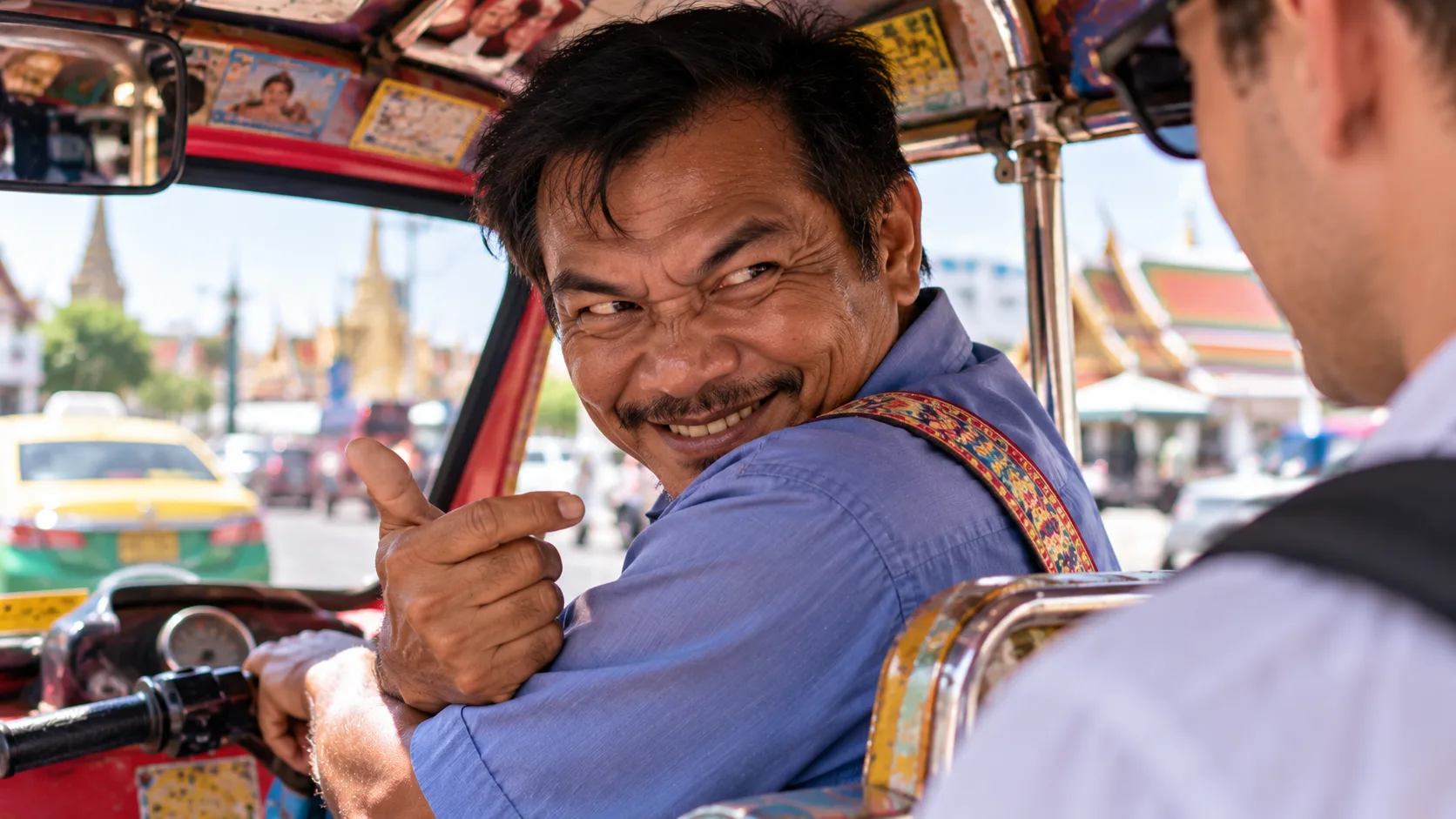
The “Grand Palace is closed” detour

A friendly stranger or tuk-tuk driver says the palace or a famous temple is closed today — then offers a “better” temple that somehow ends at a gem shop, tailor, or overpriced souvenir stop with commission built in.

Smart move: Check the official hours yourself. Say a clear “no thanks” and keep walking. Real closures are rare and never need a jewelry showroom as Plan B.

Meter

Taxi with no meter — or a “broken” meter

Still common around tourist hotspots and some airport queues. A flat price shouted at the curb is almost always for their benefit.

Smart move: Get in only after they agree to the meter (meter, please). Or open Grab / Bolt / inDrive and let the app set the fare. Note the plate before you ride.

Fees

Hidden fees & tourist pricing

National parks and some attractions post dual tickets — Thai rate and foreigner rate. That part is legal policy, not a street scam. The sneakier hit is souvenir markups on main tourist strips and “special” tickets sold by unofficial helpers.

Smart move: Buy tickets at the official counter. For gifts, compare one mall price or local market before you buy jade, suits, or “rare” Buddha amulets from a stranger’s cousin.

Grab

Widely used, card-friendly, clear pickup pins. Still confirm plate and driver name in the app before you sit down.

Bolt & inDrive

Often competitive on price. Same rule: match the plate, share your trip status with a friend if it’s late.

Public taxi cues

Metered taxis show a roof light and a visible plate. If the driver refuses the meter or insists on a “shortcut tour,” exit politely and call another car.

If something feels off — passport held at a shop, pressure to transfer money, or a dispute that won’t end — call Tourist Police 1155 (24 hours). Save the number before you need it.

Local Life Hacks

Small habits that make the trip feel local

เกร็ดเล็กเกร็ดน้อยที่ทำให้ทริป smooth

Not glamorous. Extremely useful. Pack, eat, and handle a rough day the way people who live here already do.

Packing light for Thailand’s heat, rain, and temple stops

Weather & packing

Heat and sudden rain rewrite outfits faster than fashion does.

  • A compact umbrella beats both midday sun and monsoon bursts.
  • Grip sandals matter more than pretty shoes on wet soi tiles.
  • Light layers + one temple-ready outfit (shoulders and knees covered).
  • Reef-safe sunscreen, electrolytes, and a soft scarf for sudden temple stops.
Choosing busy Thai street food stalls with fast turnover

Street food rule

Busy stalls turn food over fast — that turnover is your friend.

  • Choose queues of locals over empty carts with multilingual menus.
  • Watch meat and seafood sitting in the heat; hot-off-the-wok is safer.
  • Start mild if your stomach is new to Thai spice; ask for mai phed (not spicy).
  • Carry wet wipes and a small bottle of water. Pepto or similar in the day bag is insurance, not paranoia.
Local pharmacy care for minor travel ailments in Thailand

Pharmacy & emergency

For mild colds, stomach upset, or mosquito bites, a neighborhood pharmacy with a pharmacist on duty is often enough — and far cheaper than flying home with a suitcase of meds.

  • Bring a photo of any prescription labels you rely on.
  • Private hospitals in major cities are excellent for serious issues; travel insurance that covers clinics in Bangkok is worth packing digitally.
  • Save the numbers below in your phone before day one.
  • 1155Tourist Police · 24h
  • 1669Medical emergency
  • 191Police
  • 1672TAT info · 08:00–20:00

Before You Fly

Interactive quick checklists

เช็คลิสต์ก่อนบิน

Tick what you’ve done. Your progress stays in this browser so you can come back while packing.

Money & cards

Money & cards

Phone & maps

Phone & maps

Timing & papers

Timing & papers

Day-one comfort

Day-one comfort

0 of 16 ready — keep ticking.