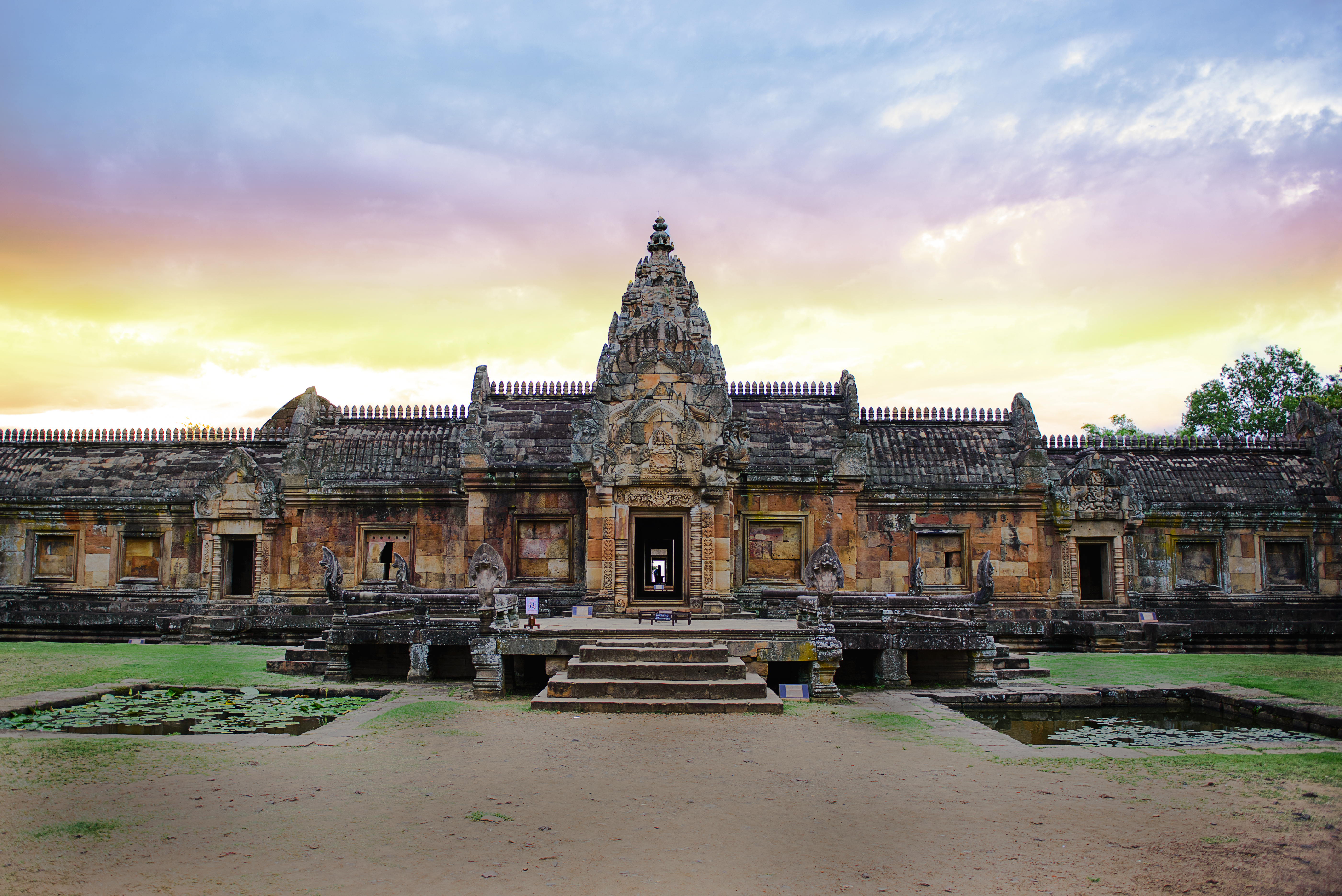

On the ridge at Ban Phum Sarol, Sisaket, a small Khmer sanctuary still holds its main tower and mandapa — quiet evidence of a road that empires used long before modern borders were drawn.
Prasat Don Tuan sits among the Phanom Dong Rak mountains, in a landscape that today is often discussed for Thailand–Cambodia border tension. ThailandLover looks at it first as heritage: a sanctuary travellers can still read in brick, laterite, and one surviving inscription.
What remains is clear enough to picture the original plan. The main prasat, with a mandapa in front, is relatively well preserved and faces east. Two accompanying buildings survive mainly as bases. A pond still marks the sacred precinct.
One inscription, a turning year
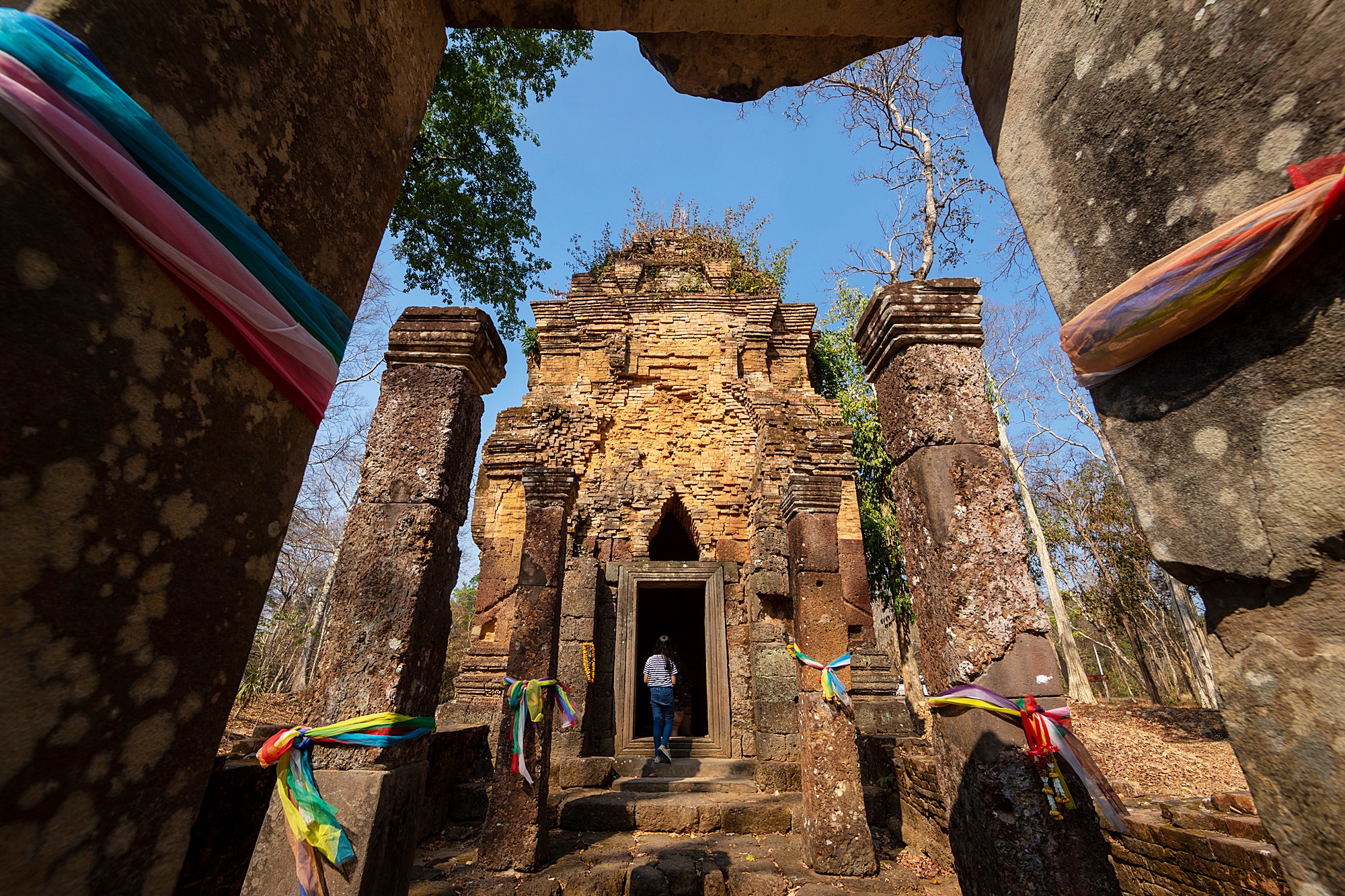
No foundation chronicle survives for Don Tuan. What we have is sharper and stranger: a single inscription on the doorframe of the mandapa entrance.
It records that the sovereign ordered a proclamation to capture two runaway slaves and dedicate them as servants of the god Kamrateng Jagat — dated to 1002 CE (B.E. 1545). That year was the last of King Udayadityavarman I and the first of King Suryavarman I. The stone does not describe a coronation; it captures a kingdom mid-shift, in the language of law and offering.
The mountain road to the lake
Around Don Tuan and the pass of Chong Ta Tao, the ridge opens a corridor between the Khorat Plateau and the Tonle Sap lowlands. In the Khmer world this was not an edge — it was a hinge. Towns, shrines, and waystations once lined the route; many still leave stone and laterite along the trail.
The border is modern. The road is older than either flag.
If you descend from Chong Ta Tao toward the Cambodian plain and follow the Dongrak east for roughly 50–60 kilometres, you reach the foothills of Phnom Chisor — home to Prasat Neak Buos, a larger sanctuary whose main tower feels like Don Tuan’s architectural twin.
A twin below the ridge: Prasat Neak Buos
Neak Buos is the larger sibling — a thoughtfully planned sanctuary on a mountain slope, facing south toward the plain. Laterite terraces step the temple up the hillside; stairways invite the faithful toward the tower. The dialogue with terrain recalls Prasat Ta Muean Thom on the Thai side of the same range.
The complex holds many buildings and inscriptions across periods. From pre-Angkor times it is linked to Śivapāda pūrvva — the “Eastern Footprint of Shiva.” Scholar Kangwon Katchima (Faculty of Archaeology, Silpakorn University) has suggested this eastern footprint relates to a western counterpart that stands as the principal cult of Ta Muean Thom.
Two doorway inscriptions on the front attendant towers (K.342E and K.342W) cite Suryavarman I ordering nobles to offer goods, land, and servants to Śivapāda pūrvva and to Liṅgapura — here likely meaning Wat Phu — in 1008 and 1015 CE.
Tracing the craft: why these two look alike
Don Tuan and Neak Buos differ in scale, yet share a rare silhouette. Both follow a classic square plan with corner offsets, a single front door, an inner cella for the cult image, load-bearing walls, and a corbelled crown. Their special mark — uncommon elsewhere — is a main tower of half brick and half laterite, with a mandapa in front.
That hybrid points toward the workshop culture of Koh Ker (Chok Gargyar / Liṅgapura), capital of the Khmer realm for only about seventeen years (928–944 CE), yet wildly inventive with laterite, brick, and stone. Provincial sanctuaries kept that freedom alive beside the court styles of Yasodharapura. Don Tuan and Neak Buos sit in that “outside the capital” lineage.
Four threads from Koh Ker
- Mixed materials Koh Ker normalised laterite for main towers. Half-brick, half-laterite appears later at Koh Ker itself — including Prasat Dan, dated by inscription K.674 to 966 CE under Rajendravarman II, after the capital had returned to Yasodharapura.
- Building technique Stone columns, stone capitals, and laterite walls drilled for timber roofs — the same logic as Don Tuan and Neak Buos — begins in Preah Ko–period Hariharalaya and becomes clear at Koh Ker sites such as Prasat Krachap’s gopura and attendant buildings at Prasat Thom, then continues into Bakheng-era work at the capital.
- Plan and style Neak Buos, with a main tower ringed by eight small attendant prasats, echoes Prasat Banteay Pir Choan at Koh Ker and the ruined Prasat Dap near the Dongrak. Its lintels also lean toward Koh Ker taste.
- The mandapa grows up A projecting mandapa before the main tower may descend from the brick main sanctuary at Prasat Thom. Don Tuan’s mandapa, though, is more developed — with engaged columns, collar beams, and a pitched roof — closer to Khleang and early Baphuon stone work: the antechamber at Preah Vihear, Prasat Baset, Prasat Ek Phnom, and the brick mandapa at Phnom Chisor.
Seen this way, Don Tuan and Neak Buos are not footnotes. They are missing pieces in the jigsaw of Khmer architecture beyond the capital — places that help explain how craft travelled when the map had no modern borders.
Afterword: heritage across a line on the map
Follow the resemblance in material, technique, and plan from Don Tuan outward, and a corridor appears: Koh Ker to early Baphuon, mid-10th to early 11th century — from northern Angkor country up to the Dongrak. Hybrid brick–stone–laterite shrines cluster along that arc.
That hybrid taste may have lasted into the early reign of Suryavarman I, when he still ruled outside Yasodharapura. Scholars often place his early power east of the capital, with the Dongrak as another base. After he secured the capital in 1010 CE, stone temples outside the royal city multiplied.
On the Khorat Plateau, brick remained the favourite body of a prasat into Baphuon times — and sometimes to Angkor Wat — while stone took a larger role in the main tower. The great exception is the Mahidharapura line, which could raise full stone sanctuaries from the Baphuon age onward — as at Phimai.
This short reading of Don Tuan compares Koh Ker, Banteay Srei, Bakheng, Khleang, and early Baphuon forms to imagine a cultural world before nation-state borders. In tense seasons along the ridge, ThailandLover still asks visitors to look for the older connection: shared craft, shared mountains, and the people who keep walking them.
Inscription dates and comparisons follow published epigraphic and art-historical readings (including work discussed by Kangwon Katchima). Access to cliff-edge sites near the border can change — always check local guidance before you travel, and treat every sanctuary as sacred ground.